
OpenAI Jalapeño Chip: Challenging Nvidia's AI Dominance

Key Takeaways
- OpenAI has introduced Jalapeño, a custom inference ASIC co-developed with Broadcom using TSMC's 3nm node.
- The chip demonstrates superior power efficiency, claiming up to 1.9x more throughput per kilowatt than Nvidia's Blackwell GB300.
- Benchmarks show Jalapeño delivers up to 3.6x lower latency across specific modern models including GPT-OSS, DeepSeek R1, and Kimi K2.5 1T.
A New Era of Custom AI Silicon: The Birth of Jalapeño
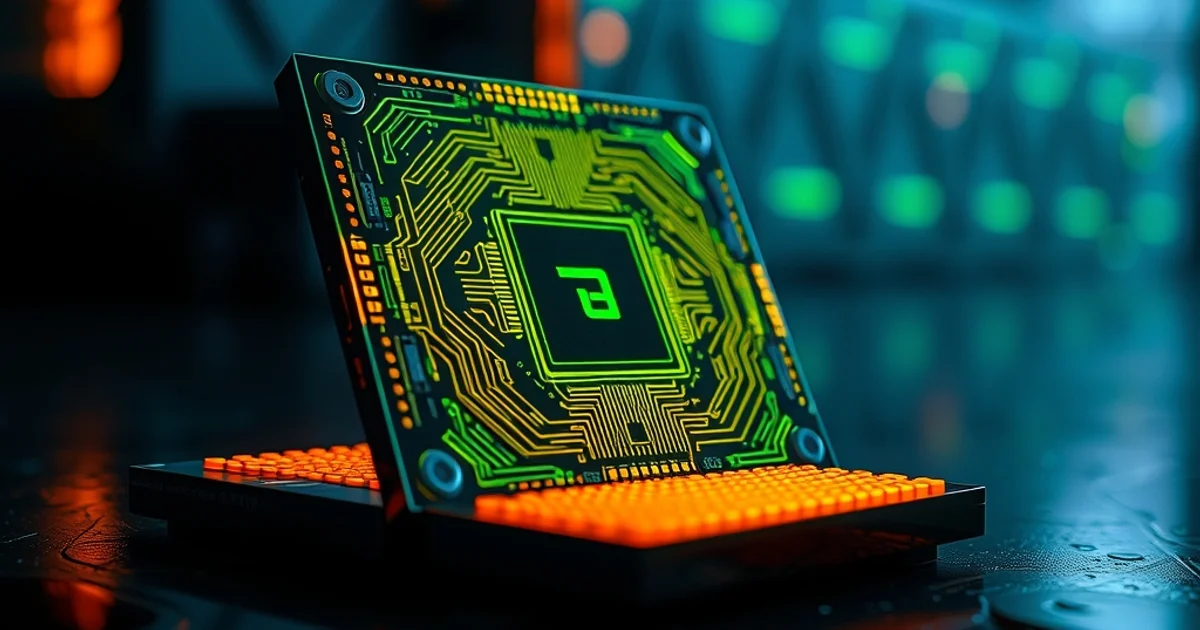
OpenAI has officially revealed the first results for Jalapeño, a custom-designed inference chip aimed at increasing the speed and efficiency of modern AI models. Unveiled at the Hot Chips 2026 conference on August 25, the Jalapeño ASIC (Application-Specific Integrated Circuit) represents a strategic move toward self-designed hardware to optimize throughput and reduce latency across the company's vast ecosystem.
Developed in a rapid collaboration with Broadcom—taking only nine months from conception to reveal—and manufactured on TSMC's cutting-edge 3nm node, Jalapeño is specifically engineered for AI inference. Unlike general-purpose GPUs, this ASIC is tailored for the specific mathematical workloads of Large Language Models (LLMs). OpenAI reports that the chip delivers industry-leading efficiency, providing faster performance and higher throughput while remaining significantly more power-efficient than existing alternatives.
TechStartups notes that the chip is part of a broader push by OpenAI to control more of the infrastructure behind ChatGPT, Codex, its API business, and the upcoming wave of agentic AI products. By focusing on inference—the stage where a trained model generates responses—OpenAI is targeting the most expensive and compute-heavy part of the AI lifecycle.
Benchmarking Against Nvidia Blackwell: The Performance Gap
The primary focus of the Jalapeño reveal has been its performance relative to Nvidia's flagship hardware, specifically the Blackwell architecture. Byteiota reports that the chip was tested against the Nvidia Blackwell GB300 across three specific high-demand models: GPT-OSS, DeepSeek R1, and Kimi K2.5 1T. In these rigorous tests, Jalapeño delivered between 1.5x to 1.9x more AI work per watt, signaling a massive leap in energy efficiency.
The efficiency gains are further highlighted by the drastic difference in power draw. Tom's Hardware notes that OpenAI's 700W Jalapeño ASIC outpaces the 1,400W Nvidia flagship GPU. This means that while consuming half the power of its competitor, Jalapeño claims up to 1.9x throughput per kilowatt. Furthermore, the chip achieves a significant reduction in latency, which is up to 3.6x lower than the competition, allowing for near-instantaneous AI responses.
SemiAnalysis adds that Jalapeño beats Blackwell on performance per watt across nearly all tested scenarios. Crucially, these results were achieved without the chip being tuned for any specific point in the performance curve, suggesting that the architectural advantages are inherent to the design rather than the result of narrow optimization.
Architectural Innovation and the Role of Broadcom
The partnership with Broadcom was pivotal in bringing Jalapeño to market so quickly. Forbes highlights that this collaboration strengthens Broadcom's role as a primary infrastructure provider for the AI era, acting as the bridge between OpenAI's architectural requirements and TSMC's manufacturing capabilities. Richard Ho, OpenAI's VP of Hardware, has discussed the novel architecture of Jalapeño, emphasizing that it is built from the ground up to handle the specific memory bandwidth and compute requirements of LLM inference.
By utilizing a 3nm process, OpenAI is leveraging the highest density of transistors available, which allows for more compute units per square millimeter and lower leakage current. This hardware-software co-design allows OpenAI to optimize how weights are moved from memory to the compute cores, which is the primary bottleneck in inference speed for trillion-parameter models.
Impact on the AI Infrastructure Landscape
The introduction of Jalapeño signals a seismic shift in how AI giants approach the "CUDA moat"—the software ecosystem that has kept developers locked into Nvidia's hardware for a decade. By designing its own silicon, OpenAI is targeting the critical bottlenecks of power consumption and latency that plague large-scale AI deployments. This move allows OpenAI to decouple its growth from Nvidia's supply chain and pricing models.
Wccftech describes the first-generation ASIC as "blowing the competition out of the park," specifically citing its ability to perform significantly more work per kilowatt than Blackwell chips. This is not just a technical victory but a financial one; reducing power consumption by half while increasing throughput directly lowers the Total Cost of Ownership (TCO) for the data centers powering ChatGPT.
The Botshelf suggests that this is part of a coordinated industry-wide effort. With Google, Meta, and now OpenAI developing custom chips via Broadcom, the AI landscape is moving toward a fragmented and highly competitive hardware environment. This trend indicates that the world's leading AI developers are no longer content with off-the-shelf GPUs and are seeking vertical integration to achieve the operational efficiency required for the next generation of agentic AI.
The Path Forward: Scaling and Agentic AI
As OpenAI moves toward "agentic AI"—systems that can plan and execute multi-step tasks autonomously—the demand for low-latency inference will skyrocket. Agentic workflows require multiple internal "thought" loops before a final answer is delivered to the user. If each loop incurs the latency of a standard GPU, the user experience becomes sluggish. Jalapeño's 3.6x latency reduction is therefore a prerequisite for the next evolution of AI.
While Nvidia continues to innovate with the Blackwell and subsequent architectures, the emergence of Jalapeño proves that specialized ASICs can outperform general-purpose GPUs in specific domains. For OpenAI, the ability to scale its API business and consumer products without being throttled by hardware availability or electricity costs is a strategic imperative that Jalapeño is designed to solve.
Sumber / Sources
- Jalapeño's first results show industry-leading speed and efficiency in ...
- OpenAI's 700W Jalapeño ASIC outpaces 1,400W Nvidia flagship GPU ...
- OpenAI's First-Gen Jalapeno ASIC Blows Competition Out Of The ...
- OpenAI Jalapeño: 1.9x Better Than Nvidia Blackwell | byteiota
- OpenAI Jalapeño: Better Than Nvidia Blackwell - SemiAnalysis
- OpenAI Jalapeño: Better Than Nvidia Blackwell | SemiAnalysis
Relevant solution
Website Development
Custom website development — fast, modern, ready to sell.
Related Articles
OpenAI Jalapeño: Chip AI Kustom Penantang Nvidia Blackwell
OpenAI meluncurkan Jalapeño, chip AI kustom hasil kolaborasi dengan Broadcom yang mengalahkan Nvidia Blackwell dalam efisiensi daya dan latensi. Simak detail performa dan dampak strategisnya bagi masa depan AI.

Integrasi AI Sales Assistant & Payment Gateway untuk Checkout
Tingkatkan konversi chat commerce dengan integrasi AI Sales Assistant dan Payment Gateway. Pelajari arsitektur checkout otomatis yang aman, bebas double-charge, dan siap skala produksi.

MikroTrick: Celah SSH MikroTik RouterOS & Cara Mengatasinya
Waspada MikroTrick! Celah kritis SSH pada MikroTik RouterOS memungkinkan hacker mengambil alih akses admin tanpa password. Simak cara mitigasi dan langkah pembersihan total di sini.

Arsitektur Pipeline AI Document Processing untuk Production
Bangun sistem AI Document Processing yang scalable dan tahan banting. Pelajari arsitektur pipeline dari upload file, Redis Queue, hingga ingestion database untuk beban produksi nyata.
Dapatkan Artikel Terbaru!
Berlangganan newsletter kami untuk mendapatkan tips dan insight menarik langsung ke inbox Anda.
Kami tidak akan pernah membagikan email Anda (No Spam).