
Guide Dogs Evolution: From Canine Partners to AI Robotics

Key Takeaways
- Guide dogs are professionally trained assistants for the visually impaired, with training costs estimated at $50,000 per dog.
- The guide dog movement was pioneered in the late 1920s by Dorothy Eustis and a dog named Buddy.
- Technological advancements have introduced robotic guide dogs featuring 360-degree fields of view and computer vision.
The Foundation of Guide Dog Services
For individuals with legal blindness, guide dogs serve as essential partners for vision tasks, providing far more than simple navigation. While the term "seeing-eye dog" is commonly used in general conversation, Reddit notes that "Guide Dog" is the preferred term among those who utilize these animals, reflecting a professional partnership based on trust and utility. The movement to establish these services began in the late 1920s, when an American woman named Dorothy Eustis was inspired to lead the movement. Facebook's SeeingEye page highlights that a dog named Buddy served as a pivotal figure in this early effort, helping to prove that dogs could be trained to safely lead humans through complex urban environments.
The psychological impact of these animals is profound. ResearchGate notes that guide dog ownership provides significant benefits, though many visually impaired people may hesitate to apply due to the lifestyle changes required. For those who do transition to guide dog ownership, the animals do more than prevent obstacles; they enhance the handler's overall confidence and independence by reducing safety concerns during travel. This emotional and physical security allows users to engage more fully with their communities.
The Rigor of Training and Accessibility
The process of preparing these animals is rigorous, selective, and costly. Quora reports that guide dogs are professionally trained at an estimated cost of $50,000 per dog. This investment covers puppy raising, obedience training, and specialized guide work, ensuring the dog can handle diverse environments and unexpected hazards. ScienceDirect points out that obtaining and maintaining an assistant dog requires extensive training, time, and financial resources, which can create barriers to access for some individuals.
Because of this investment and the specialized nature of the training, some users must make strategic decisions regarding their mobility tools. When visiting facilities that may not be guide-dog friendly, users may decide between using their guide dog or a white cane—a tool that any visually impaired person can use. This duality highlights the ongoing need for inclusive public infrastructure that accommodates both biological service animals and traditional mobility aids.
Global Efforts and Community Support
The demand for these highly trained animals remains high on a global scale. WIN News Albury reports that Australians are being encouraged to help train the next generation of seeing eye dogs to support the more than 400,000 people in need. This community-driven approach to puppy raising is vital for sustaining the pipeline of available dogs.
Beyond the technical training, organizations like Guide Dogs of America provide opportunities for potential users to experience the "guide dog lifestyle" through events such as open houses, as mentioned by Adventures with Eve. These events are crucial for managing expectations, as the relationship between a handler and a guide dog is a lifelong commitment involving grooming, feeding, and emotional bonding. Teaching Visually Impaired also emphasizes the emotional depth of these bonds, citing memoirs where authors describe how their first guide dogs helped them navigate the daunting transition of adapting to vision loss.
The Intersection of Robotics and Vision
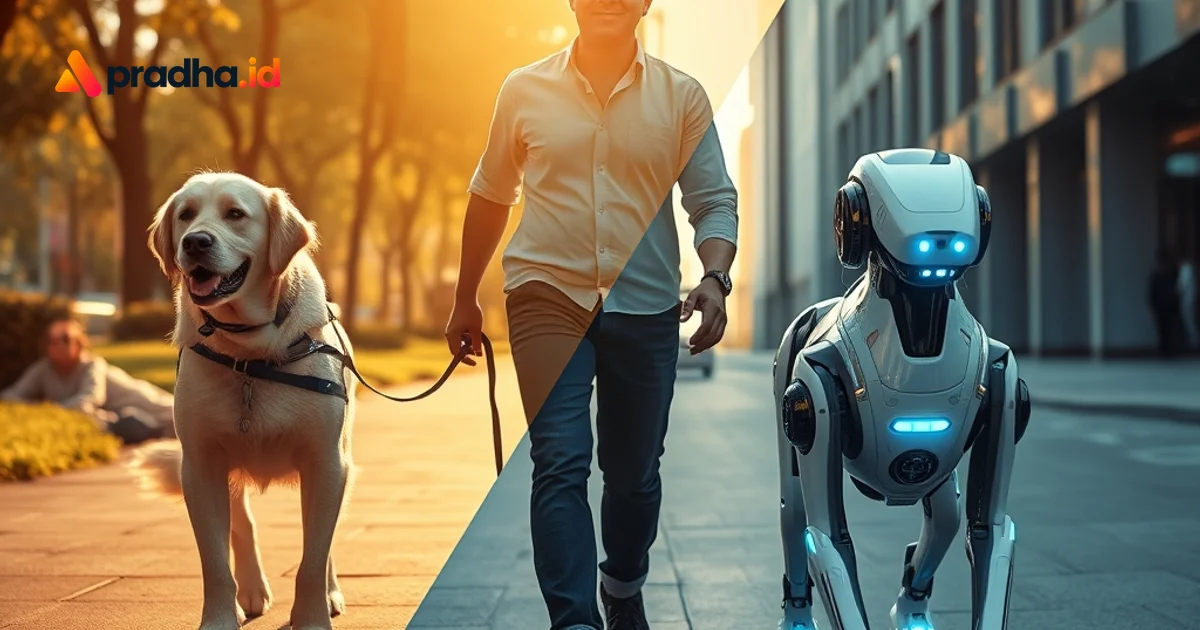
As technology evolves, the concept of the "seeing eye" is expanding beyond biological animals into the realm of robotics and artificial intelligence. This shift is not intended to replace the emotional bond of a canine but to address the limitations of biological training and the high cost of animal maintenance. Georgia Tech has showcased a guide dog that mimics a real dog by wearing a vest and responding to voice commands, but enhances capabilities with computer vision and a 360-degree field of view, allowing it to detect hazards that might be outside a biological dog's immediate focus.
The Rise of AI-Powered Assistants
Recent breakthroughs have introduced robots that can do what no biological dog can: communicate verbally. Binghamton University has developed a robot guide dog system that communicates with the visually impaired and provides real-time feedback. New Atlas further explains that these robotic guides can converse with their owners, adding a 21st-century twist to assistive technology by providing auditory descriptions of the environment.
Aussie Animals notes that these AI-powered robotic guide dogs can plan routes and narrate surroundings in real time, offering a level of precision in navigation that supplements traditional guide work. This is further supported by research from UMass Amherst, which focuses on developing a robotic mobility assistance system tailored specifically to the needs of blind and low-vision individuals using a human-centered design approach. The goal is to create a system that feels intuitive and trustworthy, mimicking the reliable nature of a canine companion.
Trust and Human-Robot Coexistence
The transition to robotic assistance brings new challenges in human-computer interaction. A study on trustworthy human-robot coexistence explores how assistive robots can be designed to earn the trust of blind or low-vision users. This involves not just technical accuracy, but the "feel" of the interaction. For instance, USC and NASA's work with robot dogs highlights the importance of terrain-sensing legs that enable the robot to "feel the surface," similar to how a biological dog senses the ground, rather than relying solely on cameras. This haptic feedback is essential for navigating uneven or dangerous terrain safely.
The New Frontier of Visual Delegation
This blend of human intuition and machine execution represents a new frontier in how visual tasks are delegated to technology. This shift is also evident in professional human-computer interaction. Clayton Ramsey describes his role as a "seeing-eye dog for a computer," where he provides visual guidance to a robot—such as circling a specific spot in red to indicate where the robot should grab a lid. In this scenario, the human acts as the "vision" for the machine, reversing the traditional guide dog dynamic.
Ultimately, the evolution from canine companions to robotic vision is not a replacement but an expansion of options. While biological guide dogs provide unmatched companionship and emotional support, AI-driven systems offer scalability, real-time narration, and 360-degree surveillance. As these technologies merge, the goal remains the same: providing individuals with visual impairments the freedom, safety, and confidence to navigate the world independently.
Sumber / Sources
- Seeing Eye Dog question : r/service_dogs - Reddit
- How to decide whether to use your guide dog or a white cane when ...
- Georgia Tech on Instagram: "Guide dogs are amazing creatures
- The woman who made Seeing Eye dogs possible This Women's ...
- Australians are being encouraged to do their part in helping train the ...
- Blog — Adventures with Eve
Relevant solution
ePWS Puskesmas
Digital reporting for public health centers (Puskesmas).
Related Articles

Arsitektur Pipeline AI Document Processing untuk Production
Bangun sistem AI Document Processing yang scalable dan tahan banting. Pelajari arsitektur pipeline dari upload file, Redis Queue, hingga ingestion database untuk beban produksi nyata.

Otomasi Invoice & Kuitansi dengan AI Document Processing
Ubah proses input invoice manual yang memakan waktu berhari-hari menjadi hitungan jam. Pelajari bagaimana AI Document Processing mengeliminasi human error dan meningkatkan akurasi laporan keuangan.

AI Sales Assistant WhatsApp: Ubah Chat Jadi Transaksi
Ubah chat WhatsApp yang pasif menjadi mesin transaksi real-time. Pelajari bagaimana AI Sales Assistant dan WhatsApp Business API dapat mengotomatisasi stok, rekomendasi, hingga pembayaran.

Visit Eden Prairie, MN: A Guide to Parks, Schools & Living
Discover Eden Prairie, Minnesota: a premier family-friendly city featuring 170+ miles of trails, top-rated schools, and the famous Eden Prairie Center.
Dapatkan Artikel Terbaru!
Berlangganan newsletter kami untuk mendapatkan tips dan insight menarik langsung ke inbox Anda.
Kami tidak akan pernah membagikan email Anda (No Spam).