
Ukraine-Russia War: Massive Drone Strikes Hit Moscow & Kyiv

Key Takeaways
- Ukraine has executed some of its largest aerial attacks on Russia, targeting Moscow with hundreds of drones.
- Russia has intensified its missile and ballistic attacks on Kyiv and other Ukrainian regions.
- Recent hostilities have resulted in civilian casualties and an incident involving a NATO jet downing a drone over Romania.
The Escalation of Long-Range Aerial Warfare
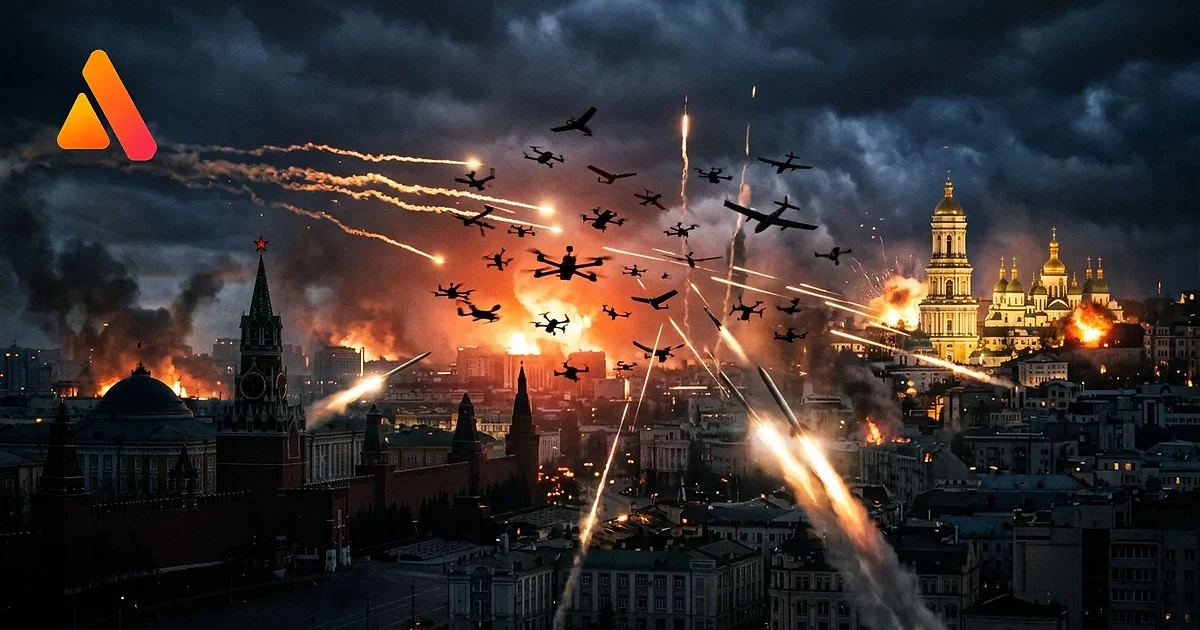
The conflict between Russia and Ukraine has entered a volatile new phase characterized by a significant escalation in long-range strikes. In a strategic shift aimed at bringing the reality of the war to the Russian heartland, Ukraine has launched a series of massive drone attacks targeting Moscow and other critical regions. These operations represent some of the largest aerial campaigns ever executed by Kyiv, signaling an increased capability in drone production and long-range navigation.
According to reports from CNN and Russian state-run news agency TASS, the scale of these attacks has reached unprecedented levels. In one of the most intense overnight engagements, Russian authorities claimed that more than 800 Ukrainian drones were shot down. While Moscow emphasizes the success of its air defense systems, the sheer volume of drones indicates a coordinated effort to saturate Russian defenses. The human toll has been immediate, with at least six people reported killed in the aftermath of these strikes.
The timing of these attacks appears calculated. Several strikes coincided with President Vladimir Putin hosting a three-day Russia-ASEAN summit in Kazan, serving as a stark reminder that Russian leadership is not immune to the reach of Ukrainian weaponry. Other reports indicate separate engagements where approximately 201 drones were downed, suggesting that Ukraine is utilizing multiple waves of attacks to keep Russian air defenses on high alert and deplete their missile stockpiles.
Strategic Targeting: Energy, Logistics, and Technology
Ukraine's aerial strategy has evolved beyond mere harassment. The focus has shifted toward "strategic degradation," targeting infrastructure that fuels the Russian war machine. A primary target in recent waves has been the Russian energy sector, specifically oil refineries in Moscow and the Saratov region. By striking refineries, Ukraine aims to disrupt the fuel supply chains necessary for Russian armored divisions and aircraft.
Beyond energy, Ukraine has targeted major export hubs. In the northern Leningrad region, drones successfully struck a major export hub, causing significant damage to two processing units. This suggests a broader economic strategy to squeeze Russian revenue streams and disrupt the logistics of military exports.
Perhaps most intriguing is the shift toward technological warfare. Reports indicate that Ukraine has successfully targeted a Russian "Starlink-style" satellite network, aiming to blind Russian communications and command-and-control capabilities. As Russia tracks Western arms packages arriving in Ukraine, Kyiv is retaliating by striking the very infrastructure Russia uses to coordinate its front-line operations. This "war of the networks" highlights how the conflict has moved into the digital and orbital realms.
Russian Retaliation: The Bombardment of Kyiv
In response to the drone offensives, Russia has intensified its bombardment of the Ukrainian capital, Kyiv, and its surrounding oblasts. These operations have seen a resurgence in the use of ballistic missiles and glide bombs, which are notoriously difficult to intercept. The Russian strategy appears to be one of "symmetric escalation," where every strike on Moscow is met with a devastating blow to Ukrainian civilian and military centers.
The human cost of these bombardments remains harrowing. Recent Russian strikes have claimed the lives of civilians, including a woman in the capital and four people—including a child—in the outskirts of Kyiv. These attacks are not merely military operations but are often viewed as attempts to break the morale of the Ukrainian population through psychological warfare and the destruction of residential infrastructure.
Military analysts describe these recent assaults as some of the largest attacks on Kyiv since the full-scale invasion began. The use of long-range drones and missiles in tandem allows Russia to overwhelm Ukrainian air defenses, which are already stretched thin due to the high demand for interceptor missiles provided by Western allies.
Regional Spillovers and the NATO Dimension
The volatility of the conflict is no longer contained within the borders of Russia and Ukraine. The airspace surrounding the conflict zone has become a high-risk area for international actors. In a significant regional incident, a NATO jet downed a drone over Romania. This event underscores the danger of "stray" munitions and drones drifting into NATO territory, raising the specter of a direct confrontation between Russia and the North Atlantic Treaty Organization.
The incident in Romania highlights the precarious nature of the Black Sea region. As Ukraine expands its reach into Russian territory, the likelihood of accidental incursions into neighboring countries increases. NATO has remained cautious, providing intelligence and equipment to Kyiv while attempting to avoid a direct kinetic engagement with Moscow, yet the Romanian incident proves that the "buffer zones" are shrinking.
Ground Shifts: The Liberation of Dnipropetrovsk
While the air war dominates the headlines, significant shifts are occurring on the ground. Kyiv has claimed the liberation of Dnipropetrovsk, a strategic victory that could alter the logistics of the eastern front. This claim comes at a time when Russian missile attacks are intensifying across the region, suggesting that Russia is attempting to use its air superiority to stall Ukrainian ground advances.
The liberation of key areas like Dnipropetrovsk provides Ukraine with better staging grounds for further offensives and secures vital transport corridors. However, the victory is tempered by the continuous rain of Russian missiles, which target everything from military barracks to civilian power grids, ensuring that any liberated territory remains under constant threat.
Conclusion: A War of Attrition in the Skies
The current trajectory of the Ukraine-Russia conflict suggests a transition into a total war of attrition, fought not only in the trenches but in the skies. The massive drone swarms launched by Ukraine and the ballistic barrages unleashed by Russia indicate that both sides are seeking a decisive blow that can force the other to the negotiating table.
As Ukraine continues to refine its long-range capabilities and Russia doubles down on its bombardment of civilian centers, the risk of further escalation remains high. The involvement of NATO assets in neighboring airspace and the targeting of high-tech communication networks suggest that this conflict is evolving into a blueprint for future modern warfare, where drones, satellites, and long-range precision strikes are the primary instruments of power.
Sumber / Sources
- Ukraine targets Moscow in mass drone attack as Russia bombards Kyiv ...
- Russian ballistic attacks intensify as Kyiv claims Dnipropetrovsk ...
- Ukraine launches major drone attack on Russia, hits Moscow refinery
- Russian strikes near Ukrainian capital kill four, including child
- Ukraine attacks Russia with hundreds of drones in one of Kyiv's ... - CNN
Relevant solution
Website Development
Custom website development — fast, modern, ready to sell.
Related Articles

MikroTrick: Celah SSH MikroTik RouterOS & Cara Mengatasinya
Waspada MikroTrick! Celah kritis SSH pada MikroTik RouterOS memungkinkan hacker mengambil alih akses admin tanpa password. Simak cara mitigasi dan langkah pembersihan total di sini.

Daisy Ridley: From Star Wars Stardom to Versatile Actress
From her breakout role as Rey in Star Wars to her recent work in films like Cleaner and Magpie, explore the professional journey and artistic evolution of British actress Daisy Ridley.

Arab Saudi vs Kuwait: Hasil Pembukaan Piala Teluk 27
Arab Saudi awali Piala Teluk 27 dengan kemenangan 1-0 atas Kuwait di Jeddah. Gol bunuh diri Y. Al Haqan menjadi penentu kemenangan dramatis tuan rumah di Stadion Al-Inma.

Jim Acosta: From CNN Chief Correspondent to Independent Journalist
Explore the evolution of Jim Acosta from CNN's Chief White House Correspondent to a fearless independent journalist. Discover his battles for press freedom and his mission to fix 'broken' news.
Dapatkan Artikel Terbaru!
Berlangganan newsletter kami untuk mendapatkan tips dan insight menarik langsung ke inbox Anda.
Kami tidak akan pernah membagikan email Anda (No Spam).