
What is a Black Hole Star? New Cosmic Discovery Explained

Key Takeaways
- Astronomers have identified a new type of astrophysical object called a "black hole star."
- The object, named MoM-BH*-1, is a hybrid system consisting of a central black hole surrounded by a dense envelope of hydrogen gas.
- This discovery may explain the mystery of "little red dots" observed in images of the early universe.
- The object is described as being the size of our solar system and up to 100 billion times brighter than a typical star.
A Paradigm Shift in Astrophysical Classification
In a discovery that challenges the fundamental boundaries of existing astrophysical classifications, astronomers have identified a brand-new type of cosmic body: the "black hole star." This extraordinary object, located in the depths of the early universe, manifests as an extremely bright red spot and represents an entirely new class of celestial body, according to reports from MIT and other leading research sources [1, 8].
For decades, the scientific community has categorized celestial objects into distinct, non-overlapping groups: stars powered by nuclear fusion, black holes that consume matter, and galaxies that house both. However, the emergence of the black hole star suggests a hybrid state of existence that blurs these lines. This discovery, described by some researchers as a "one in a billion" find, opens new avenues for understanding how the early universe evolved and how these massive, hybrid objects formed during the cosmic dawn [5]. It forces scientists to reconsider the transition between the first generation of stars and the growth of the first black holes.
What Exactly is a Black Hole Star?
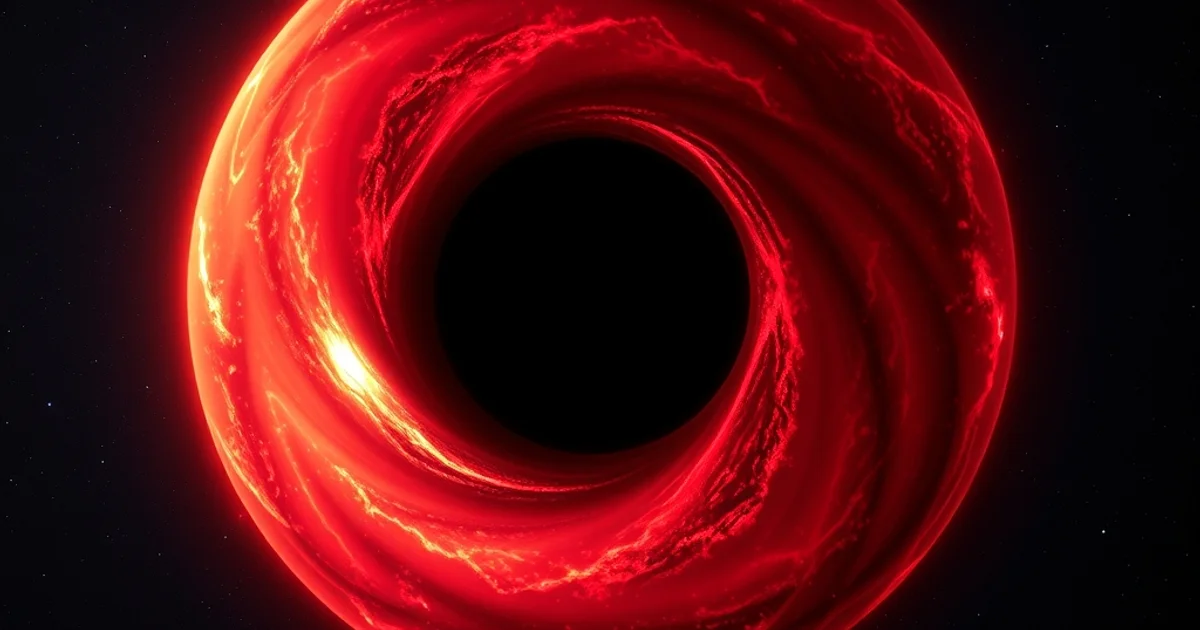
At first glance, the object resembles an enormous star in appearance. However, its internal mechanics are fundamentally different from any star found in the modern universe. According to Source 1 and Source 4, while it mimics the visual profile of a star, its energy production is more consistent with the power generated by a black hole rather than the thermonuclear fusion of hydrogen into helium.
Specifically, MIT astronomers describe the black hole star as a giant hydrogen cloud powered by a central black hole [7]. This creates a unique symbiotic relationship where the black hole acts as the primary power engine, while the surrounding dense, star-like envelope of hydrogen gas acts as a radiating shell [6]. In essence, it is a black hole so swaddled in shrouds of dense gas that it radiates light like a star, effectively masking the singularity within a glowing cocoon [1].
Unlike a typical quasar, where gas falls into a black hole and creates a highly directional jet of radiation, the black hole star's envelope is so dense and encompassing that the radiation is diffused, making the entire object glow uniformly. This "masking" effect is what makes the discovery so surprising; for a long time, these objects may have been mistaken for traditional stars due to their spherical, luminous appearance.
The Case of MoM-BH*-1: The Prototype
To ground this theoretical discovery in evidence, researchers have identified a specific instance of this phenomenon designated as MoM-BH*-1 [8]. This particular object serves as the prototype for the class, providing the empirical data necessary to define the characteristics of black hole stars. As detailed in a new paper published in Nature, MoM-BH*-1 is described as being roughly the size of our entire solar system [3].
Despite its immense size, it does not behave like a traditional supergiant star. A supergiant star's luminosity is driven by the fusion of heavier elements in its core, but MoM-BH*-1 emits a distinct, bright red glow from the depths of space that signals a different energy source [3, 8]. The sheer scale of MoM-BH*-1 suggests that the conditions of the early universe allowed for the accumulation of gas on a scale that is virtually impossible in the current epoch of the cosmos.
Unprecedented Scale and Luminosity
The scale and brightness of these objects are staggering, defying the standard luminosity curves of known stellar objects. Data collected by the James Webb Space Telescope (JWST) indicates that a black hole star can be up to 100 billion times brighter than a standard star [2]. This extreme luminosity is not the result of fusion, but rather the result of the black hole's immense gravitational pull accelerating gas to incredible speeds and temperatures before it is emitted as radiation through the surrounding gas envelope.
This process is essentially a form of highly efficient gravitational energy conversion. As matter is pulled toward the central singularity, it heats up to millions of degrees. In a typical black hole, this radiation might escape as an accretion disk; however, in a black hole star, the dense hydrogen shell traps and re-emits this energy, creating a luminous sphere of unprecedented intensity.
Furthermore, the object possesses a distinct scarlet hue [5]. This deep red color is a result of two primary factors: the composition of the surrounding hydrogen cloud and the cosmological redshift. Cosmological redshift is the stretching of light as it travels across the expanding universe from the early cosmic era to our current telescopes. This combination makes them appear as vivid, glowing embers in the darkness of the early universe [2, 5].
Solving the Mystery of the 'Little Red Dots'
Beyond the discovery of the object itself, this finding provides a potential solution to a long-standing astronomical puzzle that has perplexed researchers using the JWST. For some time, astronomers have observed mysterious "little red dots" in high-resolution images of the early universe [6]. These dots were too small to be typical galaxies—which usually show a more extended structure—but too bright and red to be standard stars.
The discovery of the black hole star offers a compelling explanation for these sightings. Researchers suggest that these "little red dots" may actually be these hybrid black hole-star systems [6]. By identifying MoM-BH*-1, scientists now have a model to explain how a compact but incredibly luminous object could exist so early in the universe's history. This potentially rewrites the timeline of how black holes and stars co-evolved, suggesting that black holes didn't just form from the death of stars, but could have existed in a symbiotic relationship with gas clouds from the very beginning.
Implications for Early Universe Evolution
The existence of black hole stars suggests that the early universe was a far more volatile and creative environment than previously thought. The process by which a black hole becomes "swaddled" in a dense cocoon of gas suggests a specific set of conditions—likely involving high-density gas clouds and rapid gravitational collapse—that were prevalent shortly after the Big Bang [1, 7].
This discovery has profound implications for the "seed" problem in astrophysics. Astronomers have long wondered how supermassive black holes grew so large so quickly in the early universe. If black hole stars were common, they may have served as the "seeds" for the supermassive black holes that now reside at the centers of almost every large galaxy, including our own Milky Way [9, 10]. By starting as a hybrid object with a massive reservoir of hydrogen to consume, these black holes could have accelerated their growth far beyond the rates predicted by standard accretion models.
As more data flows in from the JWST, astronomers expect to find more of these objects. While MoM-BH*-1 is the first to be fully described, the researchers who spotted it have already indicated that it is far from the last of its kind [8]. This discovery marks the beginning of a new chapter in astrophysics, where the line between a star and a black hole becomes blurred, revealing a universe far more complex than our current models predicted. We are now looking at a cosmic history where the very first "stars" might not have been stars at all, but the glowing shells of the universe's first monsters.
Sumber / Sources
- Astronomers discover a brand-new type of astrophysical object: A black ...
- JWST spots a bizarre “black hole star” 100 billion times brighter than ...
- Astronomers Discover the Existence of a Black Hole Star - WIRED
- Astronomers discover brand-new type of astrophysical object: A black ...
- Astronomers Discover 'Black Hole Star', A Cosmic Object Never ...
- Astronomers discovered a brand-new cosmic object - Instagram
Relevant solution
Website Development
Custom website development — fast, modern, ready to sell.
Related Articles

Daisy Ridley: From Star Wars Stardom to Versatile Actress
From her breakout role as Rey in Star Wars to her recent work in films like Cleaner and Magpie, explore the professional journey and artistic evolution of British actress Daisy Ridley.

AI Document Processing: Digitalisasi Rekam Medis & Form Kesehatan
Ubah tumpukan rekam medis kertas menjadi data digital terstruktur dengan AI Document Processing dan PWS Pradha. Tingkatkan akurasi data, percepat pelaporan, dan optimalkan layanan kesehatan Anda sekarang.

Qualcomm Brings Official Linux Support to Snapdragon X2
Qualcomm officially brings Linux to the Snapdragon X2 series, promising a phased rollout with Debian by late 2026 and Ubuntu laptops in 2027. This move solves long-standing driver issues and targets the developer community.

arXiv Secures $17.2M to Launch as Independent Nonprofit
arXiv is transitioning to an independent nonprofit with $17.2 million in philanthropic funding. Discover how this investment from the Simons Foundation will secure the future of open-access science.
Dapatkan Artikel Terbaru!
Berlangganan newsletter kami untuk mendapatkan tips dan insight menarik langsung ke inbox Anda.
Kami tidak akan pernah membagikan email Anda (No Spam).