
RSA Key Vulnerabilities: From Legacy Keys to Quantum Threats

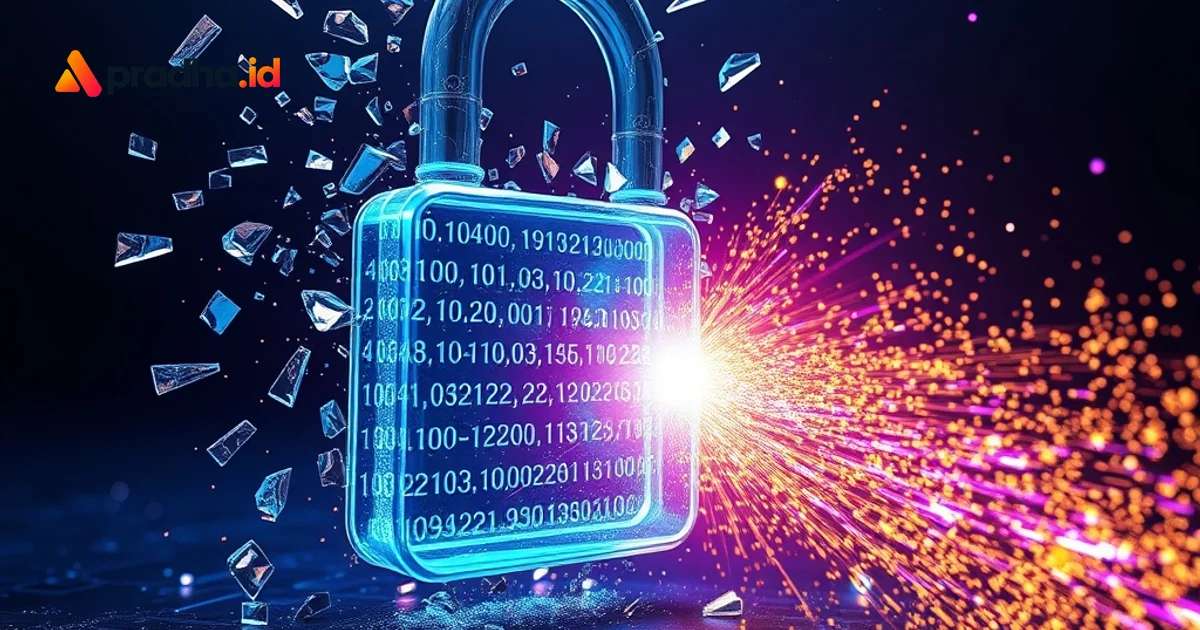
Key Takeaways
- RSA cryptography relies on the mathematical difficulty of factoring large semiprimes, a process that becomes easier as computing power increases.
- Recent reports indicate that 512-bit RSA certificates from the 1990s can now be cracked in as little as two days using consumer GPUs.
- The emergence of quantum computing poses a theoretical future tipping point that could break current public-key encryption standards, including RSA and ECC.
The Mechanics of RSA and the Erosion of Classical Security
RSA cryptography has served as the bedrock of internet security for decades, relying fundamentally on the mathematical difficulty of factoring a large semiprime—the product of two large prime numbers. For years, this computational barrier provided a reliable shield for digital communications. However, as hardware evolves and algorithmic efficiency improves, the security margins of older keys have diminished to the point of obsolescence.
Recent findings shared via mcpherrin.ca highlight the successful factoring of RSA keys belonging to a Certificate Authority from the 1990s. This demonstration proves that old RSA roots can still yield working signing power, allowing attackers to potentially impersonate trusted entities if those legacy certificates are still trusted by any part of a system's chain. The feasibility of these attacks has shifted from the realm of theoretical academic exercises to practical, low-cost operations.
Hacker News notes that a 512-bit certificate can now be cracked in approximately two days using a consumer GPU. This vulnerability is particularly significant because much of the network traffic from that era did not utilize ephemeral keys (Perfect Forward Secrecy). Consequently, historical data captured years ago may now be exposed as the keys used to encrypt them become trivial to factor.
Real-World Applications of Key Factoring
Beyond the analysis of legacy certificates, independent researchers have applied factoring techniques to specific, high-value targets. For instance, ud2.rip reports the successful factoring of a real 509-bit RSA key. This was achieved by converting several gaming PCs into a "weekend supercomputer," which was then leveraged to decrypt an entire dataset. This underscores a dangerous reality: the barrier to entry for breaking mid-range legacy encryption is no longer limited to nation-states, but is accessible to anyone with a cluster of high-end GPUs.
These vulnerabilities extend deep into authentication systems that the global economy relies upon. Postquantum.com explains that payment terminals authenticate cards using a certificate chain rooted in the card network's certificate authority, often employing RSA or ECC (Elliptic Curve Cryptography) key exchange. As factoring becomes more accessible and computationally cheaper, the continued reliance on these traditional public-key systems becomes a systemic point of failure.
Palo Alto Networks warns that using outdated cryptographic standards provides a false sense of security while leaving data vulnerable to decryption, specifically citing insufficient key lengths as a primary TLS certificate risk. When organizations fail to rotate keys or upgrade to modern standards, they leave a trail of "cryptographic debt" that can be exploited retrospectively.
The Quantum Tipping Point: Shor's Algorithm
While consumer GPUs can handle smaller legacy keys, the future of encryption faces a more existential threat: the Quantum Computer. Traditional encryption relies on the fact that classical computers are very slow at factoring large numbers. However, a sufficiently powerful quantum computer changes the mathematical landscape entirely.
Dell Technologies explains that using Shor’s Algorithm, a quantum computer can solve the factorization and discrete logarithm problems that give RSA and ECC their strength. Once Cryptographically Relevant Quantum Computers (CRQCs) exist, the digital signatures protecting software updates, the keys establishing TLS sessions, and the certificates authenticating devices can all be compromised. This is not merely a theoretical risk; it is a systemic threat to the mechanisms of digital trust.
The Quantum Insider notes that RSA keys of any practical length—whether 1024-bit, 2048-bit, or 4096-bit—can be broken by a sufficiently large quantum computer. This includes Elliptic Curve Cryptography (ECC), including algorithms like ECDSA (Elliptic Curve Digital Signature Algorithm), which were once thought to be more efficient and secure alternatives to RSA.
Systemic Risks to National Infrastructure
The implications of a quantum break extend far beyond encrypted emails. Arxiv reports that in a post-quantum context, both RSA and ECDSA are vulnerable to signature forgery via Shor’s algorithm. A compromised or forged CSCA (Country Signing Certificate Authority) or DS certificate would enable adversaries to produce counterfeit ePassports or eIDs that pass automated border checks. Such a capability would undermine national identity infrastructures and the ICAO Public Key Directory (PKD), leading to global consequences including identity fraud and the circumvention of visa restrictions.
Furthermore, Accutive Security emphasizes that Public Key Infrastructure (PKI), the backbone of digital trust used to secure websites, emails, and online transactions, relies heavily on RSA and ECC. If the root of trust is broken, the entire chain of trust collapses, rendering digital certificates useless for verifying the identity of a server or a software provider.
The Race Toward Post-Quantum Cryptography (PQC)
Facebook posts from Ajai Chowdhry describe this as a future technology inflection point. When quantum computers reach critical mass, they will break the public-key encryption that serves as the bedrock of internet security. This realization is driving a global race toward "quantum safety" to protect national security and financial infrastructure.
The urgency is compounded by the "Harvest Now, Decrypt Later" threat model. Joao Silva via Medium suggests that if nation-state actors are interested in your data, they are likely harvesting encrypted traffic now, intending to decrypt it once a quantum computer becomes available. For organizations with long-term data sensitivity requirements, the "encryption apocalypse" has already begun.
To combat this, the industry is migrating toward NIST PQC Standards. An IACR eprint paper notes that many legacy systems operate exclusively on quantum-vulnerable algorithms like RSA, ECDH, and AES-128. Migrating these systems is a massive engineering undertaking. Joao Silva suggests that organizations should determine their regulatory compliance horizon and subtract 3–5 years for migration time to establish a safe start date for their transition to quantum-resistant algorithms.
Safe Security adds that while ECC uses the algebraic structure of elliptic curves over finite fields to create secure keys, these too are vulnerable to future large-scale quantum attacks. The transition to PQC is not just an upgrade; it is a fundamental shift in how the world secures digital identity and privacy.
Sumber / Sources
- I've factored the RSA keys of a Certificate Authority…
- To address quantum's national security challenges, the United ...
- the "authoritative" game coordinator that wasn't - ud2.rip
- I've factored the RSA keys of a Certificate Authority from the 90s
- SURFACE | Home
- I have lived through multiple technology inflection points ... - Facebook
Relevant solution
Website Development
Custom website development — fast, modern, ready to sell.
Related Articles
Keamanan RSA: Ancaman Faktorisasi & Era Pasca-Kuantum
Kunci RSA 512-bit kini dapat dipecahkan dalam dua hari menggunakan GPU konsumen. Pelajari bagaimana ancaman komputer kuantum dan Algoritma Shor memaksa dunia beralih ke kriptografi pasca-kuantum.
Quantum Computing: Apa Itu, Mengapa Kita Harus Peduli, dan Bagaimana Masa Depannya di Tanah Air
Sebagai senior developer yang sudah lelah dengan tutorial setengah matang, saya mengupas tuntas quantum computing: prinsip fisika, tantangan implementasi di...

Pengantar Blockchain: Dari Bitcoin hingga Smart Contracts – Analisis Mendalam Seorang Senior Developer Indonesia
Saya mengupas blockchain secara teknis, mengungkap mitos tutorial dangkal, dan menelusuri tantangan implementasi di tanah air. Dari dasar kriptografi...

Visit Eden Prairie, MN: A Guide to Parks, Schools & Living
Discover Eden Prairie, Minnesota: a premier family-friendly city featuring 170+ miles of trails, top-rated schools, and the famous Eden Prairie Center.
Dapatkan Artikel Terbaru!
Berlangganan newsletter kami untuk mendapatkan tips dan insight menarik langsung ke inbox Anda.
Kami tidak akan pernah membagikan email Anda (No Spam).